Ship Cleaning Services in Dubai
Ship cleaning services in Dubai cover hull cleaning, cargo tank and cargo hold cleaning, ballast tank cleaning, bilge and engine room cleaning, and deck and superstructure preparation — carried out alongside at Jebel Ali and Port Rashid, in-water at anchorage, or in dry dock. A full cleaning scope on a mid-size vessel typically takes 12 hours to 5 days depending on the tanks, the previous cargo, and whether the work is done afloat or in dock.
If you are running a tight port rotation in the UAE, cleaning is rarely a standalone job. It sits between your last discharge and your next load, and every hour it slips is an hour of hire you don’t get back. This guide explains what each cleaning service actually involves, what the compliance requirements are in UAE waters, how long the work takes, and what drives the price.
Arrange Ship Cleaning in Dubai
Send us the vessel particulars, previous and next cargo, the port and the laycan, and you’ll get a method statement and a fixed quote back.
RNS Shipping
📞 Call or WhatsApp: +971 55 539 6858 ✉️ Email: info@rnsshipping.com
Our locations Damac XL, Tower 2209, Business Bay, Dubai, UAE Warehouse W-341, Dubai Maritime City (DMC), Dubai, UAE
Serving vessels at Jebel Ali, Port Rashid, Dubai Maritime City, Dubai anchorage, Khorfakkan and Fujairah.
Types of Ship Cleaning Services Available in Dubai
| Service | What it covers | Typical duration | Where it’s done |
|---|---|---|---|
| Hull cleaning | Removal of biofouling from the hull, sea chests, propeller and rudder | 6–24 hours | In-water at anchorage, or dry dock |
| Cargo tank cleaning | Washing tankers between cargo grades, wall-wash to standard | 1–5 days | Alongside, at anchorage, or in dock |
| Cargo hold cleaning | Bulk carrier holds prepared for the next grade or grain inspection | 1–3 days | Alongside or on passage |
| Ballast tank cleaning | Sediment removal, inspection and coating preparation | 2–5 days | Dry dock or alongside |
| Bilge & engine room cleaning | Degreasing, oily residue removal, tank top cleaning | 1–2 days | Alongside or in dock |
| Fuel & lube oil tank cleaning | Sludge removal, gas freeing, entry preparation | 1–4 days | Dry dock preferred |
| Hydroblasting & grit blasting | Surface preparation before coating or repair | Scope dependent | Dry dock |
| Deck & superstructure cleaning | Accommodation, deck machinery, cargo gear degreasing | 1–2 days | Alongside |
Ship Hull Cleaning in Dubai
Hull fouling is the single most expensive maintenance problem most operators ignore until it shows up in the bunker bill. A layer of soft fouling — slime and weed — can push fuel consumption up noticeably; hard fouling from barnacles and tubeworm is considerably worse and also accelerates coating breakdown underneath.
Underwater hull cleaning in the UAE is normally done by commercial dive teams at anchorage using rotating brush karts for flat surfaces, hand tools for the sea chests, gratings and rope guards, and separate polishing for the propeller. Propeller polishing on its own is one of the highest-return jobs available: a rough, fouled blade surface is a continuous drag penalty across the whole voyage.
In-water cleaning with capture is increasingly requested where the port authority restricts the release of fouling debris into the water column. Systems that collect and filter the removed material allow cleaning to proceed where open cleaning would be refused. Always confirm what the specific terminal or authority permits before the divers mobilise — permission is location-specific, not blanket.
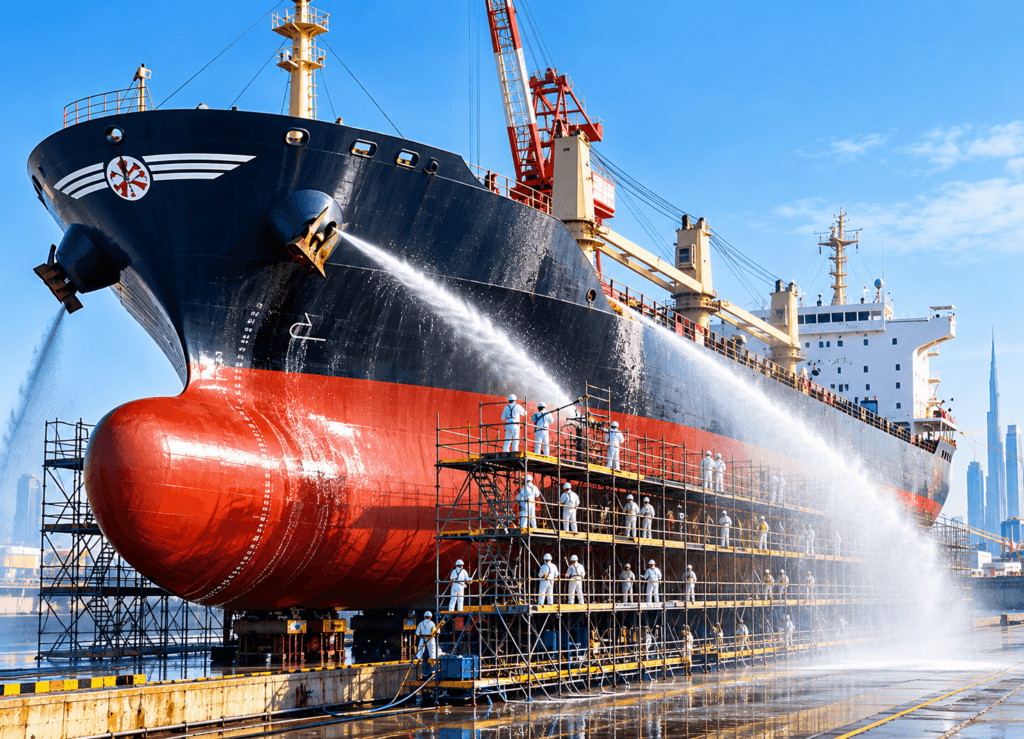
Dry dock hull cleaning — high-pressure washing, grit or ultra-high-pressure water blasting — is the route when the hull is being recoated rather than just cleaned. It removes fouling and failed coating in the same pass and gives a surface profile the new paint can bond to.
When to schedule hull cleaning
- Speed loss at constant power, or rising fuel consumption on the same route
- Long idle periods at anchorage in warm water — fouling in the Gulf develops fast
- Before a fuel-sensitive long voyage or a performance-warranty period
- Before hull inspection or a class survey
- Following a change of trading pattern into biofouling-sensitive jurisdictions
Ship Tank Cleaning in Dubai
Tank cleaning is the service with the least room for error. The tank either passes the next inspection or it doesn’t, and a failed wall-wash means the vessel sits.
Crude and product tanker cleaning runs through pre-wash, hot or cold water washing via fixed or portable machines, chemical injection where the cargo sequence requires it, mucking, drying and gas freeing. The cleaning standard depends entirely on the next cargo: water-white, methanol-clean, wall-wash to a specific hydrocarbon and permanganate time, or simply visually clean and dry.
Chemical tanker cleaning is driven by the previous cargo’s category under MARPOL Annex II and the receiver’s specification. Sequence planning matters more than chemical volume — cleaning from a heavy residue straight to a stringent grade usually costs more than routing through an intermediate cargo.
Slop and residue handling is a compliance issue, not a housekeeping one. Slops generated during cleaning have to go to an approved reception facility with the appropriate documentation, and the disposal chain is what a port state control inspector will ask to see. Confirm your provider handles collection, transfer and the receipts as part of the scope rather than leaving it to you.
Related reading: for a port-specific walkthrough, see our guide to ship tank cleaning in Jebel Ali.
Cargo Hold Cleaning for Bulk Carriers
Hold cleaning after a dirty cargo — coal, cement, petcoke, sulphur, fertiliser — is graded by what comes next. Grain-clean and food-grade standards mean no residue, no odour, no loose rust scale and no standing moisture, with the hold surviving an independent surveyor’s inspection.
Typical scope includes sweeping and residue removal, fresh or sea water washing, chemical treatment for stains and odours, rust scale removal, bilge well cleaning and bilge line testing, drying, and preparing hatch covers and coamings. Where the previous cargo has attacked the coating, spot repair may be needed before the hold will pass.
The failure point is almost always the bilge wells and the hatch cover seals. Both get inspected; both get skipped when the schedule is tight.
Ballast Tank, Bilge and Fuel Tank Cleaning
Ballast tank cleaning removes accumulated sediment, allows proper inspection of the coating and anodes, and supports compliance with ballast water management obligations. Sediment build-up is also dead weight the vessel carries voyage after voyage.
Bilge and engine room cleaning covers oily water separator areas, tank tops, sounding pipes and the machinery space in general. Beyond the obvious fire-safety benefit, a clean engine room is one of the first things a PSC inspector forms an impression from.
Fuel oil and lube oil tank cleaning is confined-space work — sludge removal, gas freeing, atmosphere testing and certified entry procedures. It is the highest-risk cleaning category on a vessel and should never be given to a crew without a permit-to-work system, gas detection and a standby rescue arrangement.
Where Ship Cleaning Is Carried Out in the UAE
- Jebel Ali Port — the main hub for alongside cleaning, tank cleaning and repair support
- Port Rashid and Dubai Maritime City — convenient for smaller vessels, workboats and yachts
- Dubai anchorage — in-water hull cleaning and underwater services
- Khorfakkan and Fujairah — East Coast bunkering and anchorage work, useful when a vessel doesn’t need to transit the Strait
- Hamriyah and Sharjah — offshore support vessels, barges and smaller tonnage
- Abu Dhabi and Mussafah — offshore fleet and OSV cleaning
Mobilisation cost is driven by distance from the team’s base, so the port you choose changes the quote as much as the scope does.
Compliance and Regulatory Requirements
Cleaning work in UAE waters sits under several overlapping regimes:
- MARPOL Annex I, II and V govern oily residues, noxious liquid substances and cargo residues, including where slops and washings may be discharged and where they must go ashore.
- IMO biofouling guidance encourages hull cleaning, biofouling management plans and record books to limit the transfer of invasive aquatic species. Several jurisdictions now inspect against it, so a documented cleaning history has practical value beyond fuel savings.
- Local port and authority rules determine whether in-water cleaning is permitted, and whether debris capture is required. This is decided port by port.
- Confined space entry standards apply to every tank, hold and void entry, with gas testing, permits and rescue cover.
- Class and flag requirements may attach to cleaning carried out as part of a survey or a coating renewal.
Ask any provider for their permits, their divers’ commercial diving qualifications, their waste disposal chain and their HSE record before award. A cheap quote that omits slop disposal is not cheaper.
How a Ship Cleaning Job Runs
- Enquiry and scope — vessel particulars, previous cargo, next cargo, required standard, port and laycan
- Quotation and method statement — scope, chemicals, manning, duration, HSE plan and waste handling
- Permits and mobilisation — port approvals, dive permits where required, equipment to site
- Pre-work checks — toolbox talk, gas testing, permit-to-work, isolation
- Execution — cleaning in planned stages with progress reporting to the master and superintendent
- Inspection — internal check, then surveyor or charterer’s inspection where a standard has to be certified
- Waste removal and documentation — slops and residues to approved reception, receipts issued
- Completion report — photos, certificates, and the record for the vessel’s files
What Affects the Cost of Ship Cleaning in Dubai
Pricing is quoted per job, not per square metre, and moves with:
- Vessel size and number of tanks or holds — the dominant factor
- Previous and next cargo — the cleaning standard required is the real cost driver
- Location — alongside, at anchorage, or in dry dock; and distance from base
- Chemicals and fresh water required for the sequence
- Slop quantity and disposal — often underestimated in comparison quotes
- Urgency and manning — round-the-clock shifts to hit a laycan cost more
- Additional work found during cleaning, such as rust scale or coating damage
Ask for the quote to separate cleaning, chemicals, waste disposal and mobilisation so you can compare like with like.
How to Choose a Ship Cleaning Company in Dubai
- Verified experience with your vessel type and your cargo sequence
- Commercially qualified divers for any in-water work, not recreational certification
- Documented confined-space entry procedures
- Approved waste reception arrangements with paperwork
- Own equipment rather than a chain of subcontractors
- Presence in the ports you actually call at
- References from operators running similar tonnage
- Round-the-clock availability, because cleaning windows rarely fall in office hours
Frequently Asked Questions
How much does ship cleaning cost in Dubai? Cost depends on vessel size, the number of tanks or holds, the cleaning standard required for the next cargo, location, and slop disposal volume. Because those variables move so widely, reputable providers quote per job after reviewing the vessel’s particulars and cargo history rather than publishing a rate card.
How long does ship tank cleaning take? Anywhere from around 12 hours for a simple like-for-like wash on a small tanker to five days or more for a full multi-tank clean to a wall-wash standard after a heavy cargo.
Can hull cleaning be done without dry docking? Yes. Underwater hull cleaning by commercial divers is routine at anchorage and needs no dry dock. Dry docking is required when the hull is being recoated or when the port does not permit in-water cleaning.
How often should a ship’s hull be cleaned? It depends on trading pattern, coating type, idle time and water temperature. Vessels operating in or laying up in warm Gulf waters foul faster than the general guidance suggests. Performance monitoring — fuel consumption at constant speed and power — is a more reliable trigger than a fixed calendar interval.
Is in-water hull cleaning allowed in UAE ports? It depends on the port and the terminal, and whether debris capture is used. Permission must be confirmed for the specific location before mobilising a dive team.
What is hold cleaning to grain-clean standard? A hold prepared so it will pass an independent surveyor’s inspection for grain: free of previous cargo residue, loose rust scale, odour and moisture, with clean bilge wells and functioning hatch seals.
Do you handle slop and waste disposal? Cleaning slops must go to approved reception facilities with documentation. Confirm this is inside your provider’s scope, and that receipts will be issued for the vessel’s records.
Can cleaning be done while cargo operations continue? Some scopes can run in parallel with cargo work, subject to terminal approval and a joint risk assessment. Tank cleaning and confined space entry usually cannot.